


Carhax LLC had a capable automotive locksmith, real demand in its service area, and the ability to take more work. What it did not have was a digital system consistently turning local intent into phone calls.
By May 5, the owner reported that inbound calls had moved from roughly three per week to three–six per day. That is a dramatic change, but the useful part is not the headline. The useful part is understanding what changed, what we can measure, and what we should not pretend to know.
This article documents the work behind the result. For the complete project, screenshots, technical stack, and owner testimonial, read the full Carhax case study.
The Starting Point: A Real Business With a Visibility Bottleneck
Automotive locksmith searches carry strong intent. Someone searching for key programming, an all-keys-lost recovery, ignition repair, or specialty vehicle support is usually trying to solve a problem now, not researching something they may buy next year.
Carhax had the expertise to serve that demand, but two major problems limited the opportunity:
- The website did not present the business with enough clarity, trust, or service depth.
- The Google Business Profile had remained unverified after about a year of previous attempts.
Without a verified local presence and a credible destination for potential customers, the owner was relying on a system that could not reliably capture the demand already available.
What Changed
1. The Google Business Profile Verification Blocker Was Removed
Google Business Profile verification was not a cosmetic task. It was the gate between an operating business and one of the most important discovery surfaces for urgent local services.
Nordax helped Carhax complete verification after the prior attempts had stalled. That gave the business a legitimate foundation for appearing in Google Maps and local service-area searches.
Verification alone does not guarantee rankings. It does make the business eligible to compete with a complete, owner-controlled profile.
2. The Website Was Rebuilt Around Urgent Customer Intent
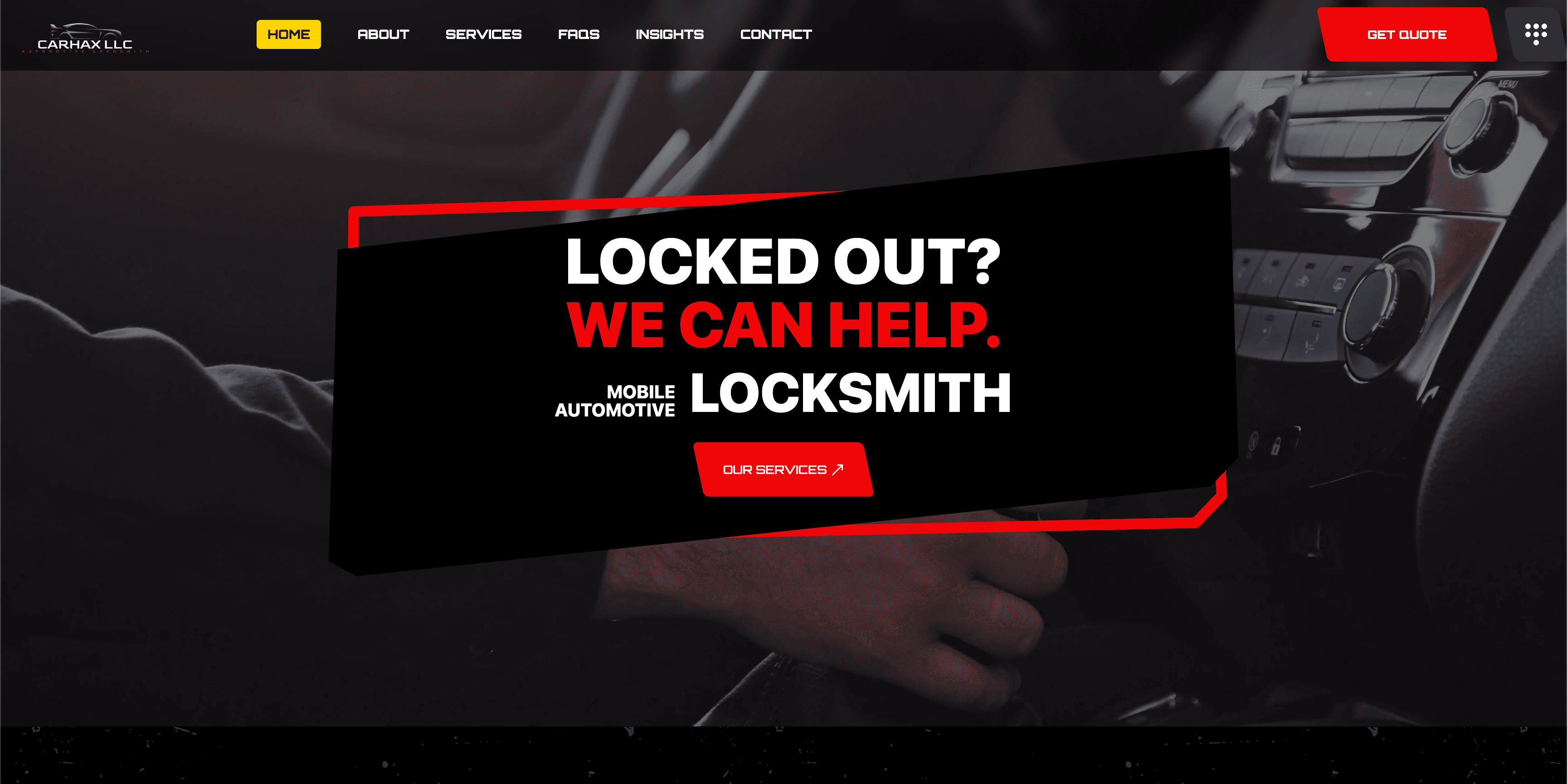
The website was redesigned as a mobile-first service system rather than a generic brochure. The new experience focused on what an automotive locksmith customer needs to establish quickly:
- Is this a real and credible business?
- Do they work on my vehicle or problem?
- Can I contact them quickly?
- Do they serve my area?
- Can I trust them with a specialized vehicle system?
The build used clear calls to action, faster media, service-specific messaging, trust signals, and straightforward quote and contact paths. Explore the broader approach on our custom website design page.
3. Service Architecture Became Specific
Instead of asking one generic page to rank for every possible need, the site was organized around real service demand: key cutting and programming, all-keys-lost recovery, ignition and door lock repair, module and ECU work, airbag module resets, fleet work, and specialty vehicle pages.
Those specialty pages addressed Mercedes-Benz, BMW, Jaguar, Range Rover, Volvo, and Sprinter owners with the language and questions relevant to those vehicles.
This was not a collection of copied doorway pages. Each route served a distinct customer need and made the business easier for people and search systems to understand.
4. Conversion Events Became Measurable
Phone clicks and form submissions were connected to analytics and Google Ads conversion events. Quote and contact requests used validation, spam protection, and reliable email routing.
That matters because visibility without measurement leaves the owner guessing. A service business should know which pages create calls, which services attract qualified demand, and where people abandon the process.
5. NDVAS Level 1 Was Deployed
The site received the foundational visibility layer defined by the Nordax Digital Visibility Architecture Specification: metadata, structured data, crawl infrastructure, security signals, semantic content structure, AI-readable files, and entity consistency.
The goal was not to add invisible code and call it strategy. The goal was to ensure the website, business identity, services, and proof told the same story to customers, search engines, and AI systems. Learn more about our local SEO and AI visibility services.
The Result and the Math
The owner’s reported baseline was approximately three calls per week. The reported post-launch range was approximately three to six calls per day.
Using the midpoint of the new range:
| Measure | Before | After |
|---|---|---|
| Calls per day | About 0.4 | About 4.5 |
| Calls per week | About 3 | About 31.5 |
| Relative volume | 1x | About 10.5x |
We describe the result as roughly 10x inbound business growth because the underlying numbers are owner-reported ranges, not laboratory measurements. Rounding down communicates the magnitude without pretending to have precision the data does not support.
What We Can and Cannot Claim
We can say that the increase followed a connected intervention: website redesign, GBP verification, clearer service pages, conversion improvements, and NDVAS Level 1 deployment.
We cannot honestly isolate one variable and claim it caused the entire increase. Local demand, seasonality, reputation, competition, response time, and the owner’s sales process can all affect call volume.
That limitation does not weaken the case study. It makes the result more useful. Businesses do not grow through isolated metadata changes; they grow when the complete discovery and conversion system works together.
What Other Service Businesses Should Take From This
Remove the Biggest Blocker First
For Carhax, GBP verification was a prerequisite. For another business, the blocker may be weak reviews, an unclear service area, a slow website, missing service pages, or calls that go unanswered.
Match Pages to Real Customer Problems
Create pages because the customer has a distinct need, not because a keyword tool produced another phrase. A useful service page should answer eligibility, process, timing, trust, location, and next-step questions.
Connect Visibility to Operations
More calls only help if the business can answer, qualify, schedule, deliver, and follow up. This is why Nordax connects websites and visibility work to CRM, booking, automation, and custom business software when the operation needs it.
Measure Leads, Not Just Rankings
The useful scorecard is qualified calls, booked jobs, proposals, close rate, and revenue. Rankings and impressions matter because they contribute to those outcomes, not because they are the final outcome.
A Practical Local Visibility Checklist
- Verify and fully complete the Google Business Profile.
- Keep business name, phone, address or service area, hours, and categories consistent.
- Build distinct pages for meaningful services and customer problems.
- Add original project photos, team information, reviews, and verifiable proof.
- Make phone, quote, booking, and contact actions obvious on mobile.
- Track calls and forms as conversion events.
- Publish structured data that matches visible page content.
- Link service pages to relevant case studies and educational resources.
- Request legitimate reviews and respond to them consistently.
- Review actual search queries and lead quality every month.
The Bottom Line
Carhax did not need another collection of marketing tactics. It needed a verified business presence, a credible website, service clarity, measurable conversion paths, and a technical visibility foundation working as one system.
That system turned occasional weekly inquiries into daily demand. If your business has real capacity but the phone is not ringing consistently, start with a visibility and website assessment. We will identify the highest-impact blocker before recommending a build.