

Terminology: This article uses the familiar term AI for artificial intelligence and AI search. At Nordax, we also discuss Super Intelligence (SI) as our terminology for increasingly capable systems. This does not mean every current AI tool is technically superintelligent. Official product names such as Google AI Overviews remain unchanged.
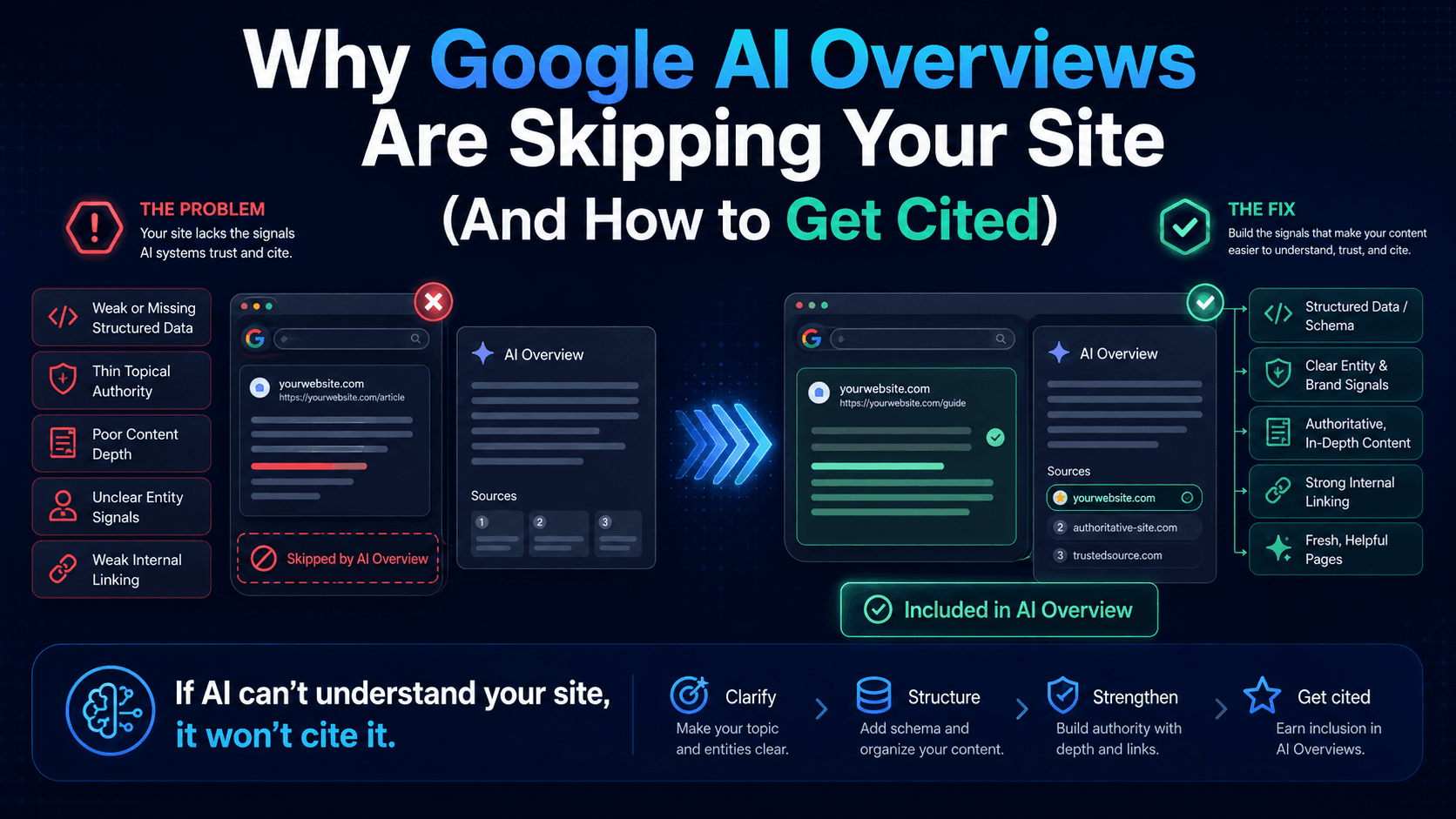
A page can be eligible for Google's AI search features and still never appear in a particular answer. That is not, by itself, evidence that the website is broken.
Google selects sources according to the query and its search systems. You cannot force a citation by adding a block of schema or rewriting every paragraph as an answer.
Check eligibility before changing the content
Google's guidance says a page must be indexed and eligible to appear in Search with a snippet to be considered as a supporting link in AI Overviews or AI Mode. Normal technical requirements and search policies apply.
Use Search Console's URL Inspection for important pages. Check crawl access, indexing, canonical selection, and snippet restrictions. A site-colon search is not a reliable inventory of every indexed page.
Google's index requirements concern Google. Other assistants use different retrieval systems; absence from Google's index does not prove absence from every AI service.
Answer the customer's actual question
Give the page a clear purpose. Explain the service or problem accurately, with detail that helps the reader make a decision. Use examples, original images, and first-hand evidence where you have it.
Do not fabricate experience or pad the page with repetitive variations of a question. More headings and more pages do not automatically produce better coverage.
Keep normal SEO practices
Descriptive titles, readable copy, relevant internal links, usable mobile layouts, and accurate business information remain useful. Search intent and keyword research help identify what readers expect.
A service page and a detailed guide have different jobs. The service page should explain the offer and next step; the guide should resolve the reader's question. Neither is automatically disqualified because it uses a particular format.
Treat structured data as supporting work
Relevant schema can help describe content and support normal Search features. Google says there is no special schema required for its generative search features.
Validate the supported types you use and ensure they match visible content. Passing a markup test does not promise a citation, ranking, or rich result.
Understand the controls before opting out
Google's preview controls, including nosnippet, data-nosnippet, max-snippet, and noindex, have different effects. Read Google's current documentation before applying them.
Google-Extended controls certain uses outside Google Search. It is not the crawler control for appearing in Google AI Overviews or AI Mode. Do not change broad indexing controls without understanding the effect on regular search visibility.
Measure a business outcome
Search Console provides search performance data, while analytics and your sales records help explain what visits produce. Follow Google's current reporting documentation rather than assuming every AI appearance can be separated in every report.
A manual search is a sample. Location, query, context, and product behavior can change what appears. Document those conditions and avoid treating one missing citation as a complete visibility diagnosis.
There is no guaranteed time to inclusion. Improve the foundations, allow time for processing, and review actual performance and inquiry quality.
Talk to Nordax if you want help identifying whether the gap is access, content, offer clarity, or the path to contact.
Sources and scope
Google's guide to optimizing for generative AI features explains that SEO fundamentals still apply. Google's AI features guidance describes eligibility and controls. These statements concern Google Search; other assistants have their own retrieval systems and policies. This article was reviewed in October 2026. No ranking, citation, traffic, or revenue outcome is guaranteed.